The history of the typewriter, 1714 to today
The history of the typewriter from Henry Mill's 1714 patent to Sholes, Remington, the Selectric and Godrej in India, with a dated timeline.
No single person invented the typewriter. The first patent for a writing machine was granted to Henry Mill in England in 1714. The first American patent went to William Austin Burt in 1829. The first machine produced for sale was Rasmus Malling-Hansen's Writing Ball, patented in Denmark in 1870. The typewriter that today's keyboards descend from was patented in 1868 by Christopher Latham Sholes, Carlos Glidden and Samuel W. Soule of Milwaukee, and E. Remington and Sons put it on sale on 1 July 1874.
So the answer to "when was the typewriter invented" runs from 1714 to 1874, depending on whether you count a patent, a working machine, a product or a commercial success. This history takes those claims in order, then follows the machine to the word processor, with a full section on typewriters in India.
Before 1860: patents and one-off machines
Henry Mill was an English waterworks engineer. In 1714 he received a patent for a machine "for impressing or transcribing of letters singly or progressively one after another", so neat that the result could not "be distinguished from print". The patent has no drawing and no description of the mechanism, and nothing more is known about the machine.
The first machines known to have worked were built in Italy for blind writers. Pellegrino Turri made a writing machine for his friend Countess Carolina Fantoni da Fivizzano in the first years of the nineteenth century. Accounts give 1801, 1806 or 1808. Another version credits Agostino Fantoni with building the machine in 1802 for his blind sister, with Turri improving it. The machine is lost, but letters the countess typed on it survive. Turri is also credited with making carbon paper to ink it, though the first patent for carbon paper went to the Englishman Ralph Wedgwood in 1806.
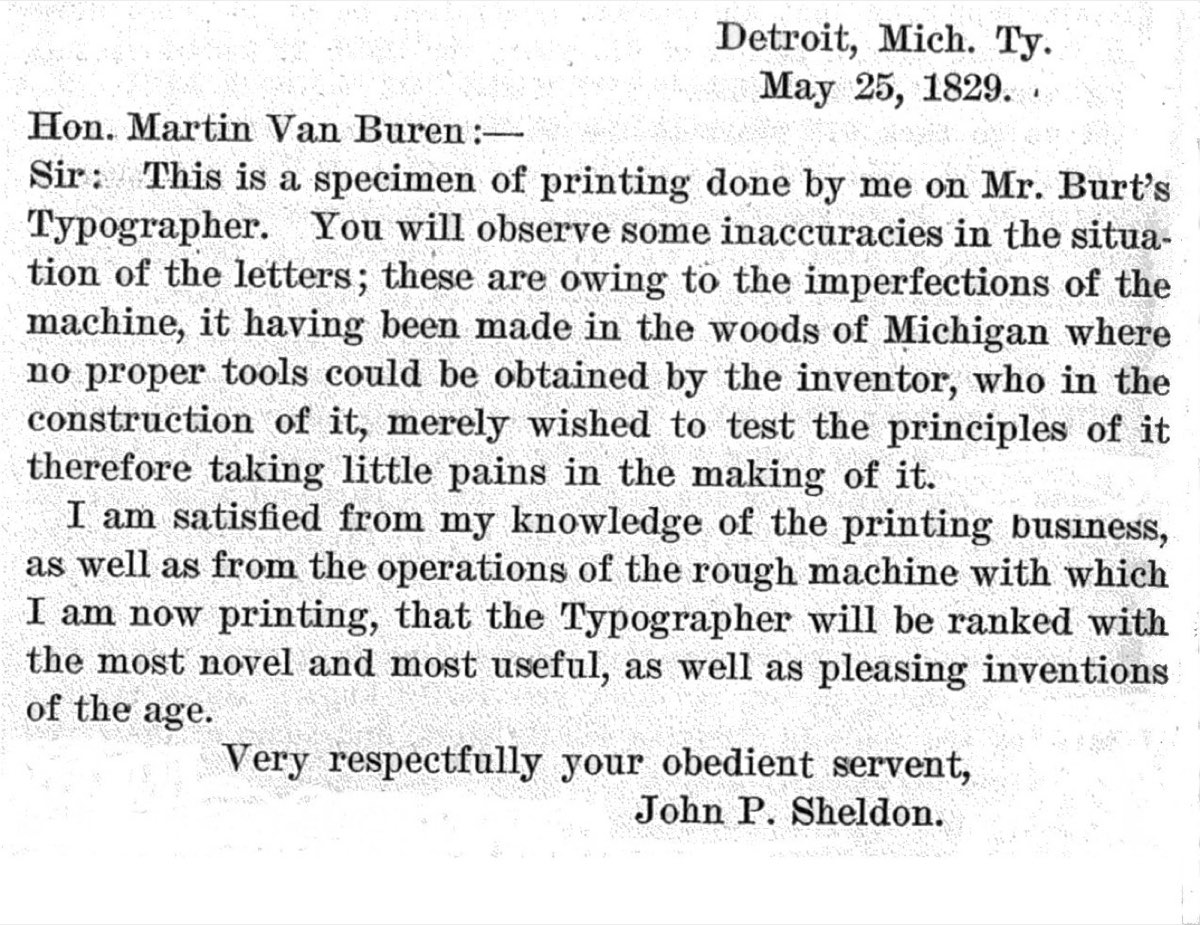
In the United States, the surveyor William Austin Burt patented his typographer in 1829. The typist turned a lever to select a letter and pressed it onto the paper, one character at a time. It was the first writing machine patented in America. It was slow and found no market, and the patent model burned in the Patent Office fire of 1836.
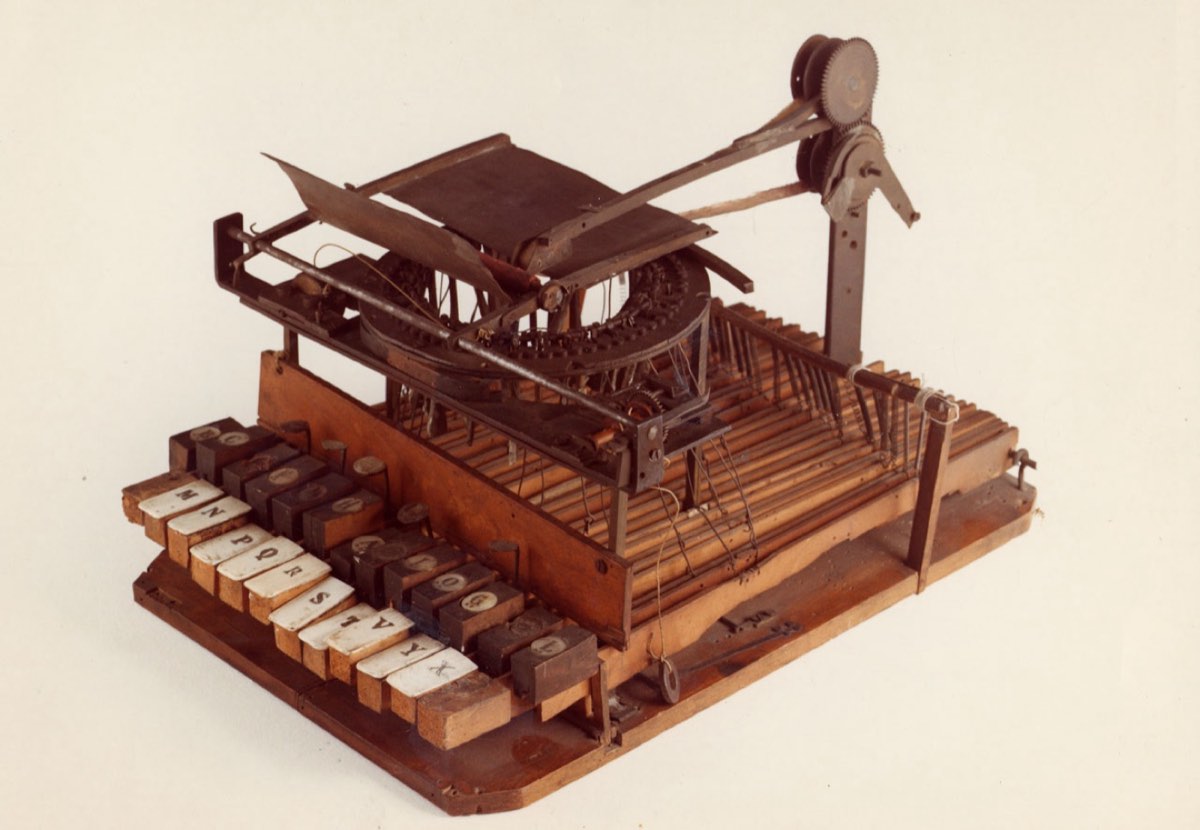
More inventors followed. Charles Thurber of Massachusetts patented a machine in 1843 that carried the paper on a roller, an idea later machines kept. In Novara, Giuseppe Ravizza spent close to forty years on a machine he called the cembalo scrivano, the scribe harpsichord, after its piano-style keys. He patented it in 1855. Its type hammers were arranged in a ring and struck upward, the same basic plan Sholes would arrive at later.
The 1860s: Brazil, Tyrol, Alabama and Copenhagen
Father Francisco João de Azevedo, a priest from Paraíba in Brazil, showed a machine with sixteen piano-like keys at the National Exhibition in Rio de Janeiro in 1861, and Emperor Pedro II awarded him a gold medal. Many Brazilians regard him as the inventor of the typewriter, a claim that is disputed elsewhere.
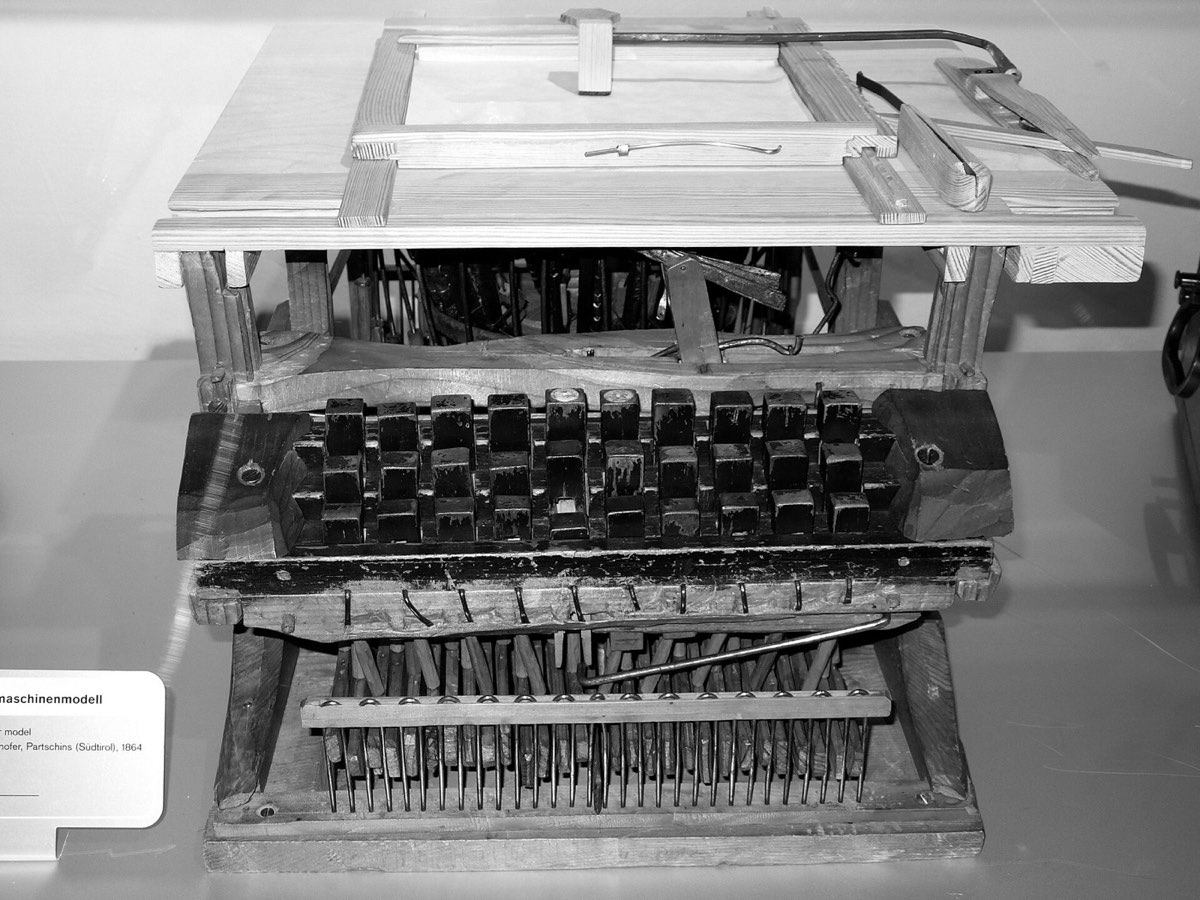
Peter Mitterhofer, a carpenter from Partschins in South Tyrol, then part of Austria, built a series of typewriter models between 1864 and 1869, the early ones largely of wood. He took them to Vienna and received a payment from the imperial court, but no manufacturer. Four of his machines survive in museums.
John Pratt of Alabama, working in England, built a machine he called the Pterotype. Scientific American described it in July 1867. That article was read in a Milwaukee machine shop.
The most successful machine of the decade came from Copenhagen. Rasmus Malling-Hansen, a pastor and the principal of the Royal Institute for the Deaf-Mutes, designed his Writing Ball in 1865 and patented it in 1870. The keys are pistons set in a brass hemisphere. Each one slides straight down to the same printing point. The earliest models moved the paper with an electromagnet powered by a battery, and a version patented in 1875 worked without electricity.
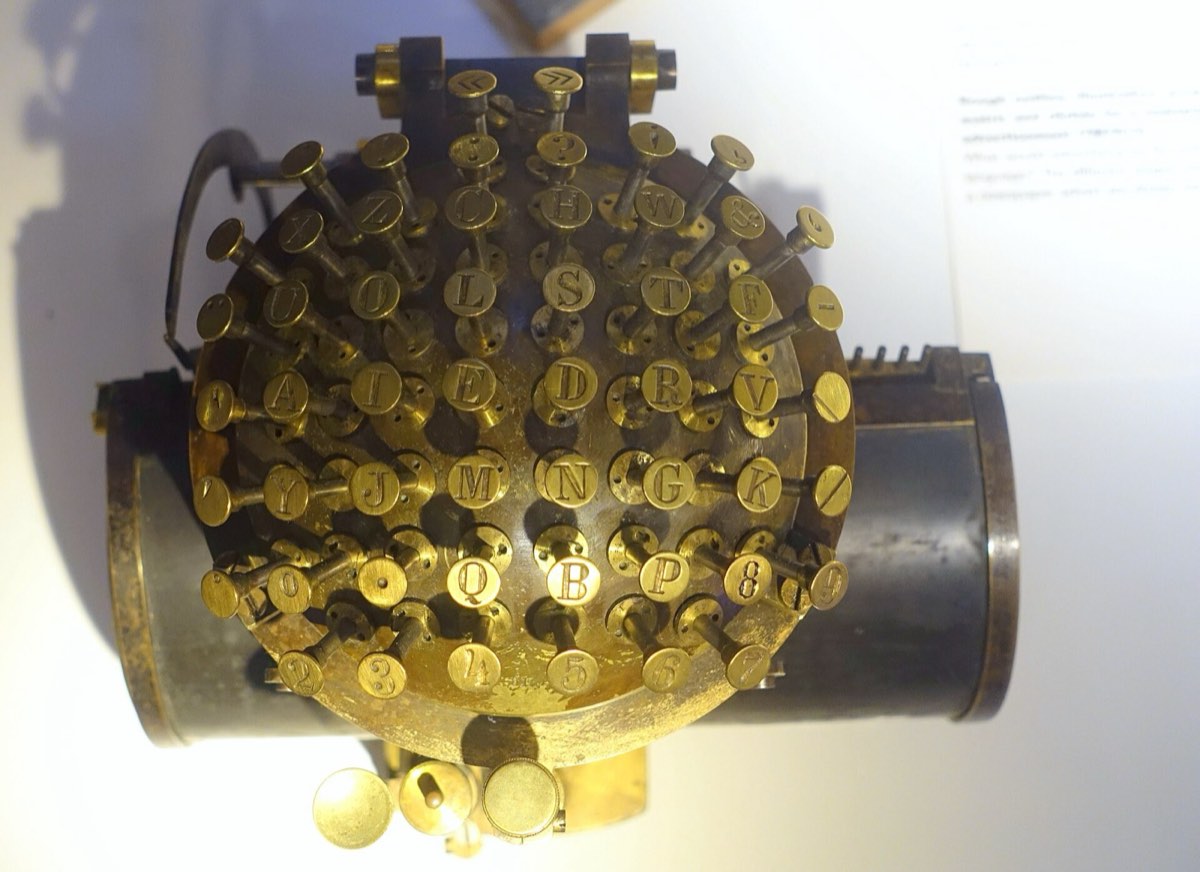
The Writing Ball was the first typewriter produced for sale. It won prizes at the world exhibitions in Vienna in 1873 and Paris in 1878. Each one was made by hand, and by the Malling-Hansen Society's account no more than a few hundred were sold. Friedrich Nietzsche, whose eyesight was failing, received one in 1882 and typed about sixty surviving texts on it. The machine had been damaged on the journey to Genoa and he never mastered it. Production ended after Malling-Hansen died in 1890.
Sholes, Glidden and Soule in Milwaukee
Christopher Latham Sholes was a Wisconsin printer and newspaper editor. In the 1860s he and another printer, Samuel W. Soule, built a machine for printing page numbers at Kleinsteuber's machine shop in Milwaukee. Carlos Glidden, an amateur inventor who used the same shop, suggested that it could print letters as well, and showed Sholes the Scientific American article on Pratt's Pterotype. Sholes thought he could do better.
The three men had a model with a full alphabet working by September 1867, with help from the clockmaker Mathias Schwalbach. They used it to type letters asking for money. One went to James Densmore, who bought a quarter share before he had seen the machine. US patent 79,265 was granted on 23 June 1868.
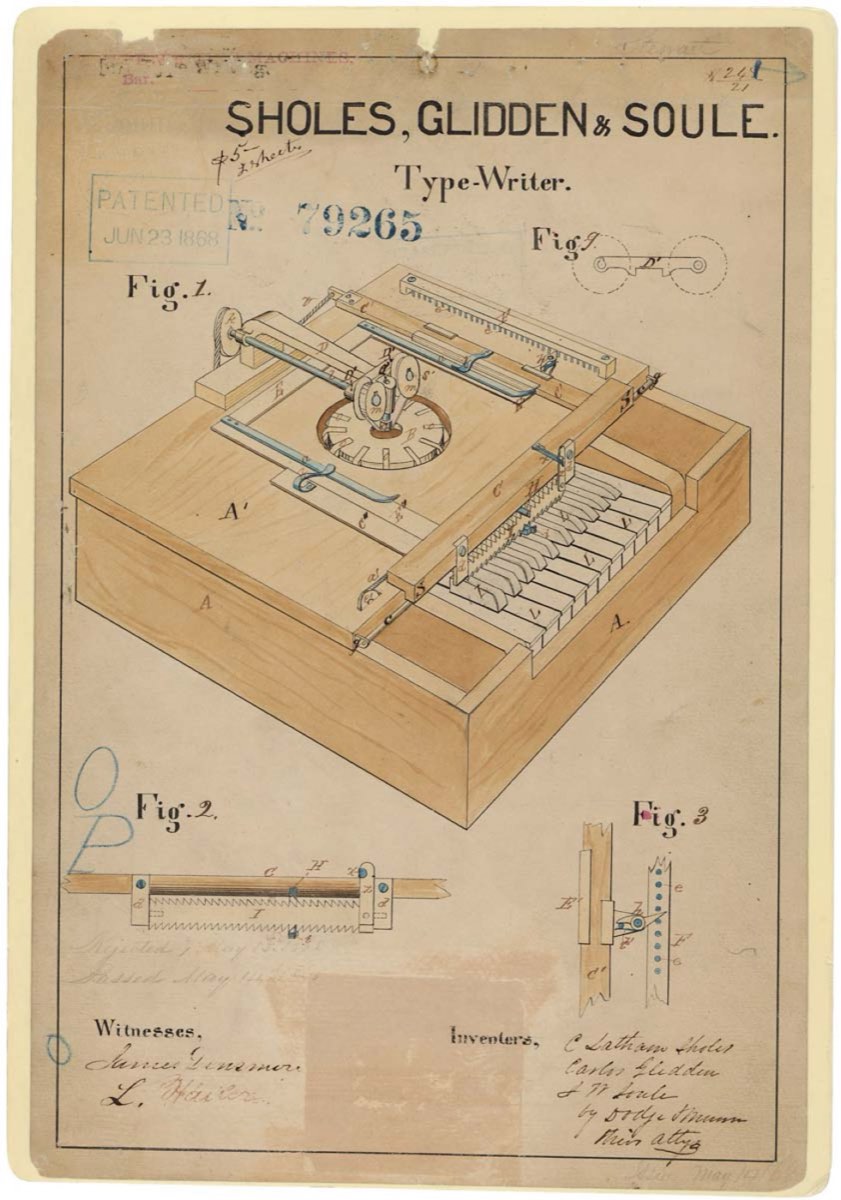
Soule and Glidden lost interest. Densmore did not. He pushed Sholes through one prototype after another for five years and sent them to working stenographers to be tested. James O. Clephane in Washington wore out several and sent back harsh reports. Twenty-five to thirty more prototypes followed. By the end of 1872 the machine had a cylindrical platen, a four-row keyboard and most of the form it would keep.
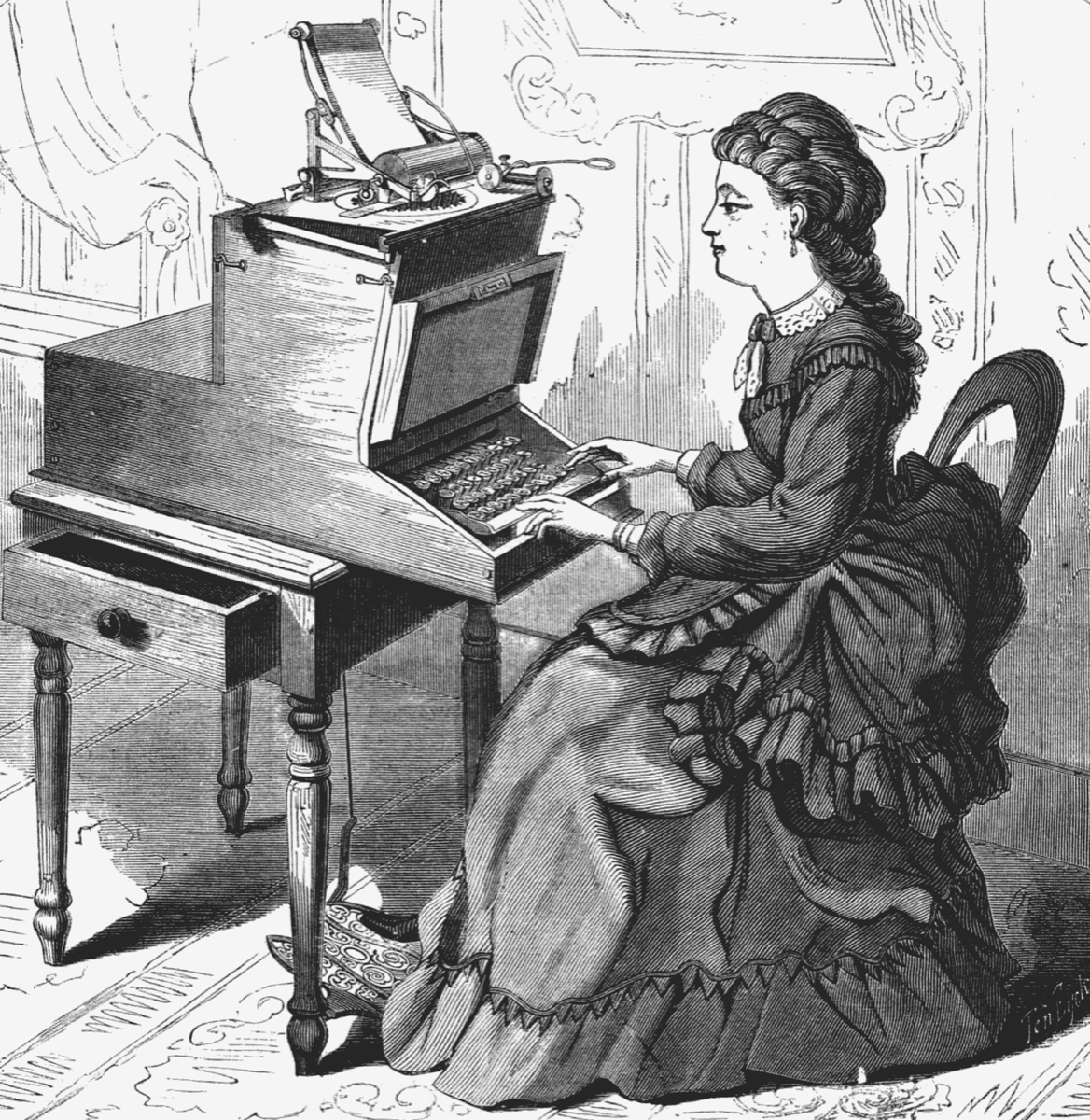
Densmore could not make it at a profit, so he took it to E. Remington and Sons of Ilion, New York. Remington made rifles and sewing machines, and had the machine tools and skilled workers the job needed. On 1 March 1873 the company contracted to build 1,000 machines. Its mechanics, who came from the sewing machine division, re-engineered it and gave it a black case painted with flowers and a treadle for the carriage return. The Sholes and Glidden Type-Writer went on sale on 1 July 1874. It was later called the Remington No. 1. The word typewriter comes from its name.
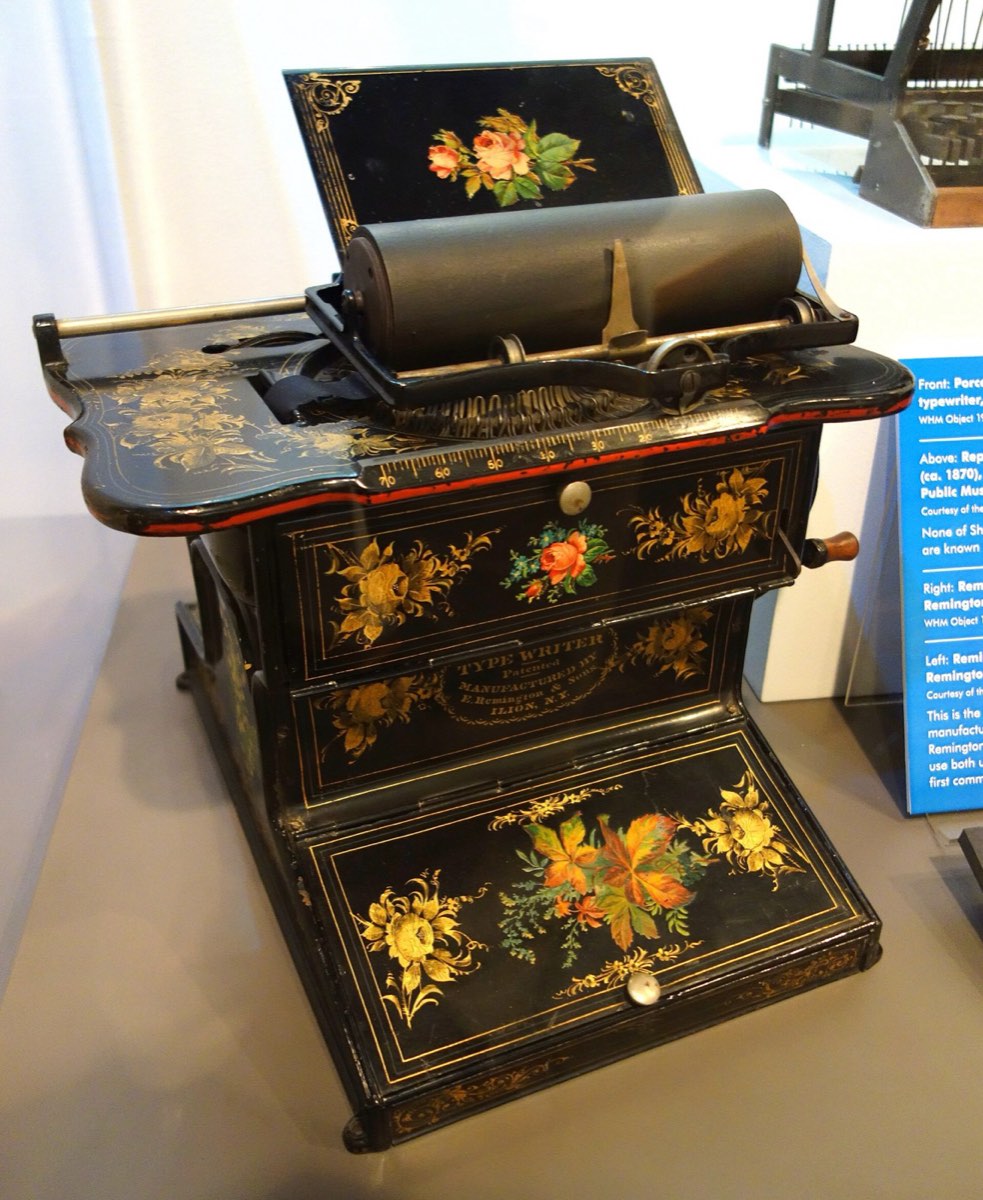
It was not an immediate success. It cost about $125, printed only capitals, and struck the paper from underneath, so the typist could not see the line being typed. By December 1874 only 400 had been sold. Mark Twain bought one that year and called it a "curiosity breeding little joker". About 4,000 had been sold by 1877.
Where QWERTY came from, and why historians disagree
Sholes's first keyboard had two rows in alphabetical order, laid out like a piano. Over five years of rearranging it became four rows, and by 1873 the top row began Q W E. Remington's mechanics made the last changes.
The usual explanation is mechanical. The typebars hung in a ring and swung up to one printing point, and two neighbouring bars struck in quick succession could collide. In this account Densmore obtained a study of common letter pairs, and Sholes moved those letters apart in the ring.
Koichi and Motoko Yasuoka of Kyoto University tested that account against the patents, letters and machines of the 1870s and argue that it does not hold. E and R, one of the commonest pairs in English, ended up almost side by side. They trace the changes to requests from telegraph operators, who were the first customers. Other histories keep the jamming explanation, so the question is open. No evidence supports the claim that the layout was designed to slow typists down. The layout's later history is in the typewriter keyboard layout article.
1878 to 1900: the shift key, rivals and index machines
In 1878 the Remington No. 2 added lowercase. Each typebar carried a capital and a small letter, and a shift key moved the platen so that one or the other met the paper.
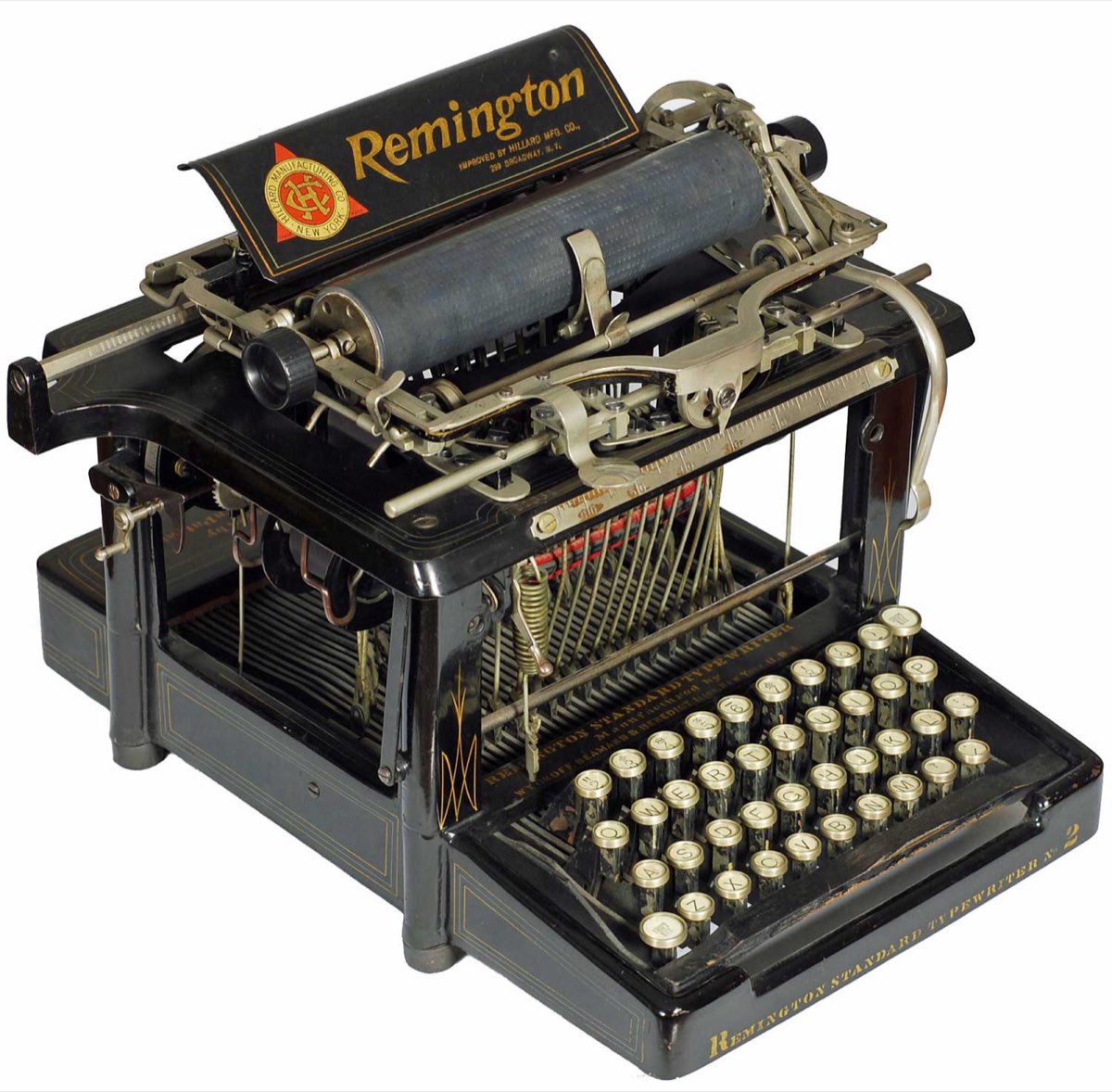
Remington had the market to itself until about 1880, when the American Writing Machine Company brought out the Caligraph. Its answer to lowercase was a full keyboard with a separate key for every capital and every small letter. The two schemes competed for years. The Hammond followed in 1884 with type on a swinging, interchangeable sector, so a typist could change typeface.
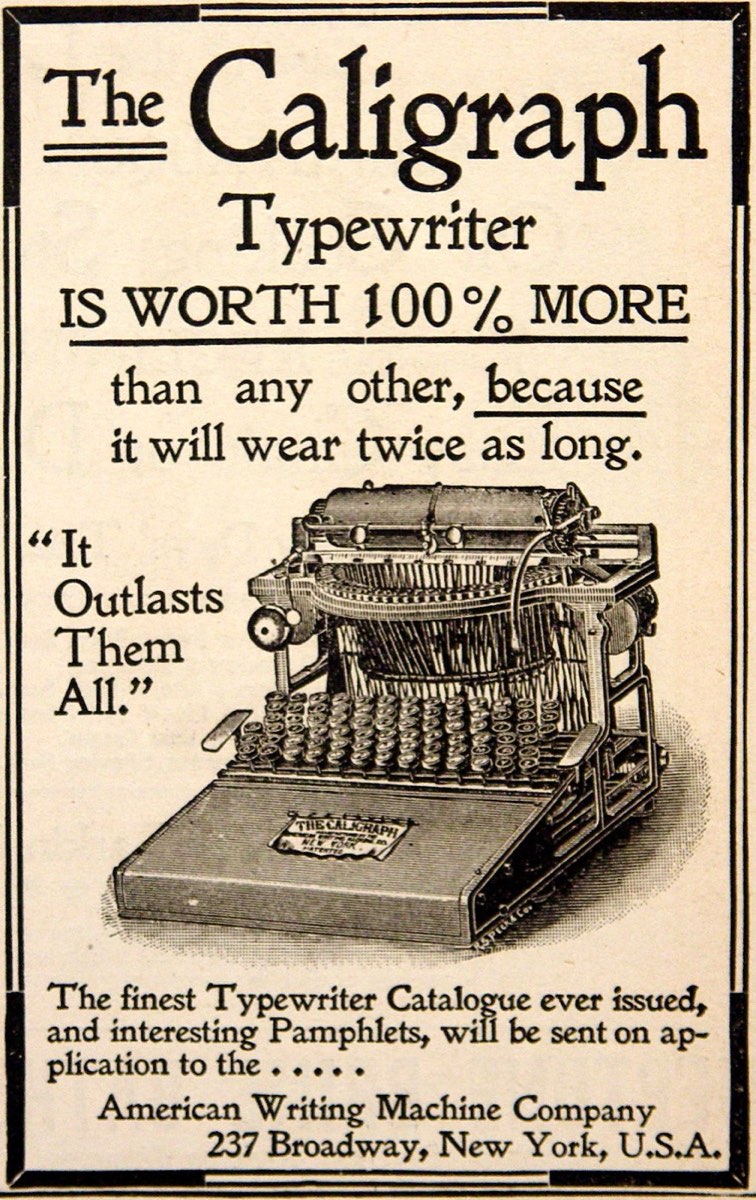
Typewriters did not become common in American offices until after the mid-1880s.
A keyboard typewriter cost $100 or more. The index typewriter was the cheap alternative. It has no keyboard. The typist moves a pointer to a letter on a chart, then presses a lever to print it. The Hall of 1881 was the first index machine made in quantity. Index typewriters were slow, light and simple. The best known, the German Mignon, was made by AEG from about 1903 to 1934.
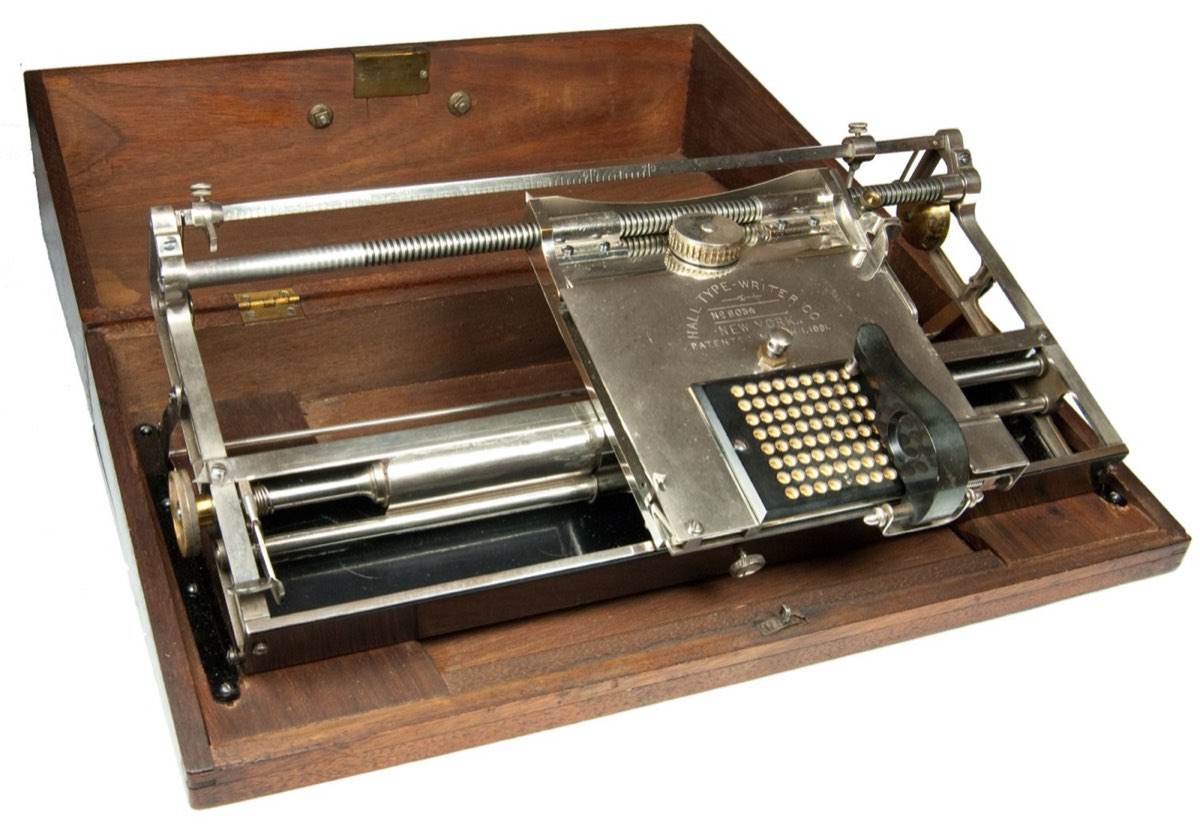
Visible writing and the Underwood
For twenty years typists worked blind. On an understrike machine the type hit the underside of the platen, and the last few lines could be read only by lifting the carriage.
The Daugherty Visible of 1893 was one of the first typewriters to strike the front of the platen instead. The design that won was drawn by Franz Xaver Wagner, a German-American engineer, from about 1892. John T. Underwood, whose family firm made ribbons and carbon paper, bought it in 1895. The Underwood No. 1 followed, and the No. 5 of 1900 became the pattern for almost every later manual: front strike, four rows of keys, a single shift, and the typed line in plain view.
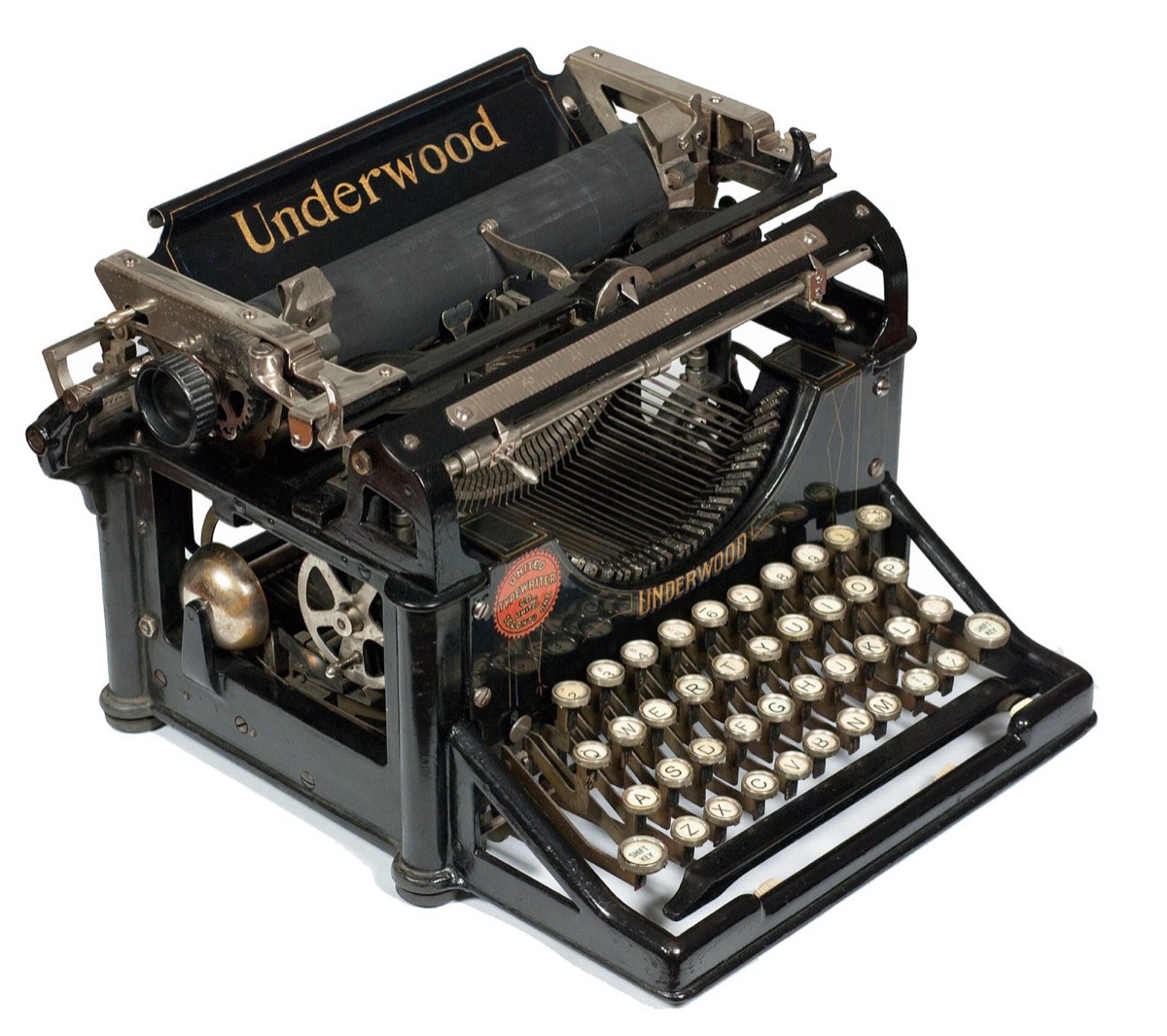
Underwood had sold two million No. 5 machines by the early 1920s. Remington, which had begun the industry, did not sell a visible model until the first decade of the new century. By about 1910 manual typewriters from different makers worked in much the same way, and that standard machine is the one described in how a typewriter works. Its two usual type sizes, ten and twelve characters to the inch, are covered in pica vs elite.
The typewriter and women's office work
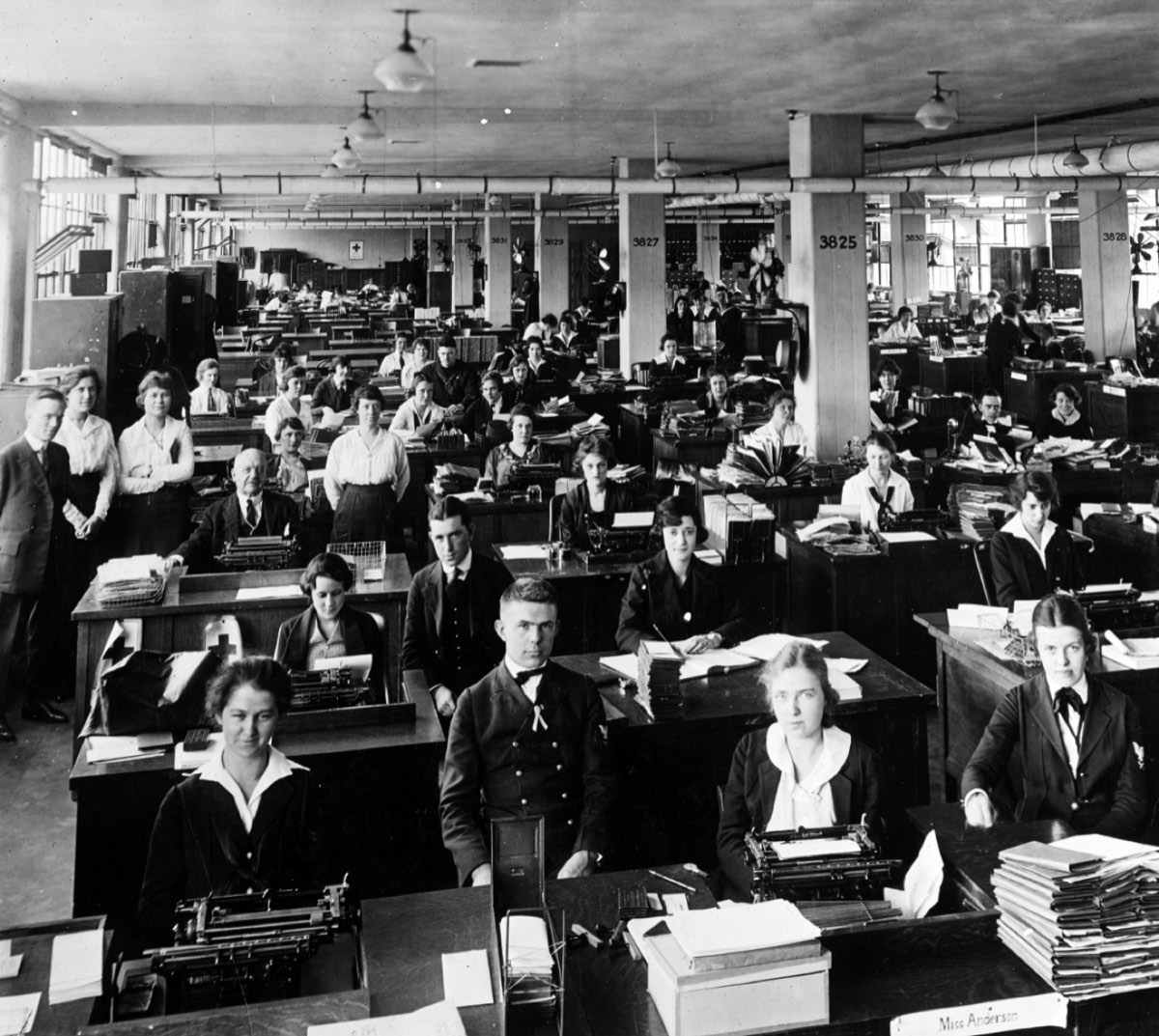
Before the typewriter, clerks were men who wrote by hand. The machine arrived as American business correspondence was growing fast, and it was new enough to belong to nobody. Margery Davies, the historian of this change, notes that it had not yet been typed as a man's tool. An 1875 Remington advertisement in The Nation already pitched it at women: "No invention has opened for women so broad and easy an avenue to profitable and suitable employment."
In 1881 the New York YWCA began training young women as typists, and they found work quickly. Davies gives the proportions among American stenographers and typists: women were 40 percent by 1880, more than three quarters by 1900 and over 95 percent by 1930. Employers paid women less than men for the same work, which was part of the appeal. The typing pool, a room of typists serving a whole office, became a fixture of large organisations.
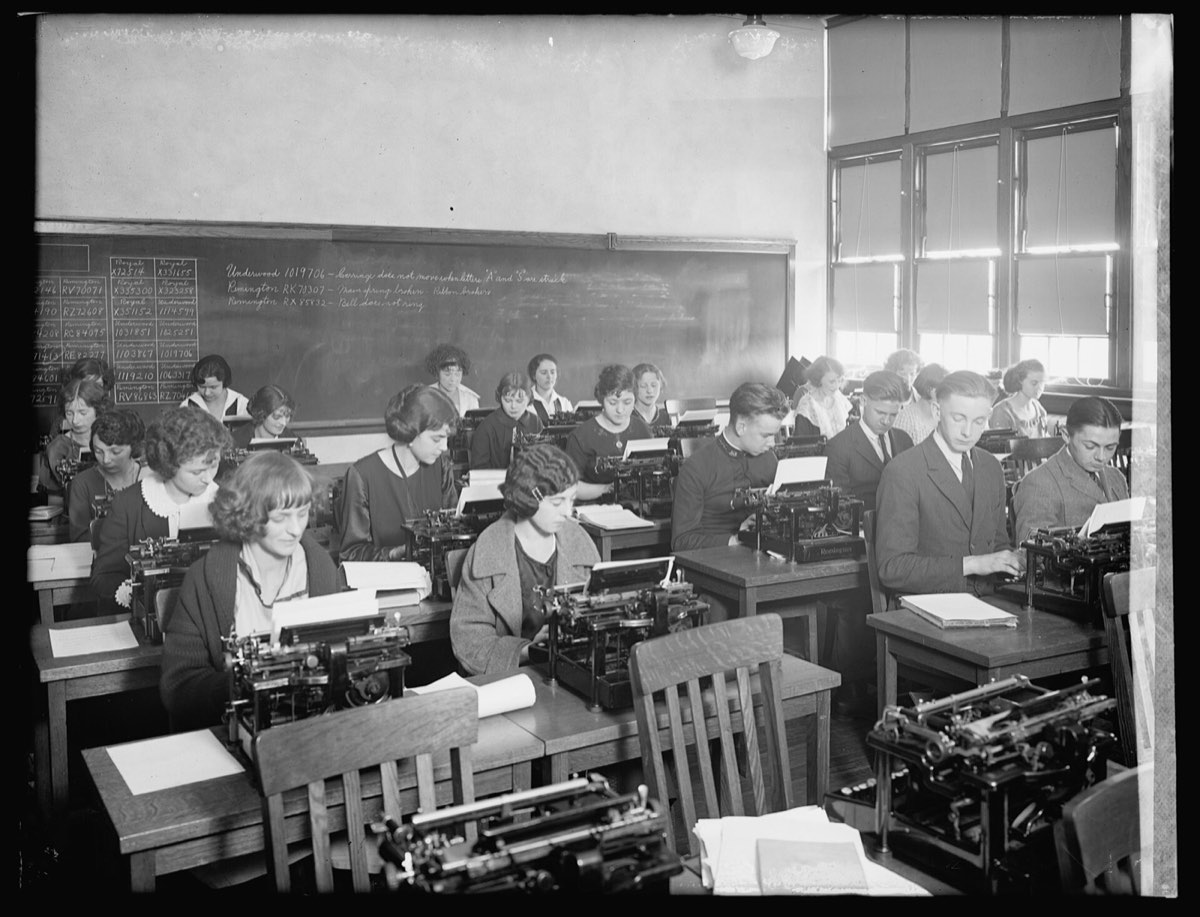
Touch typing and the 1888 contest
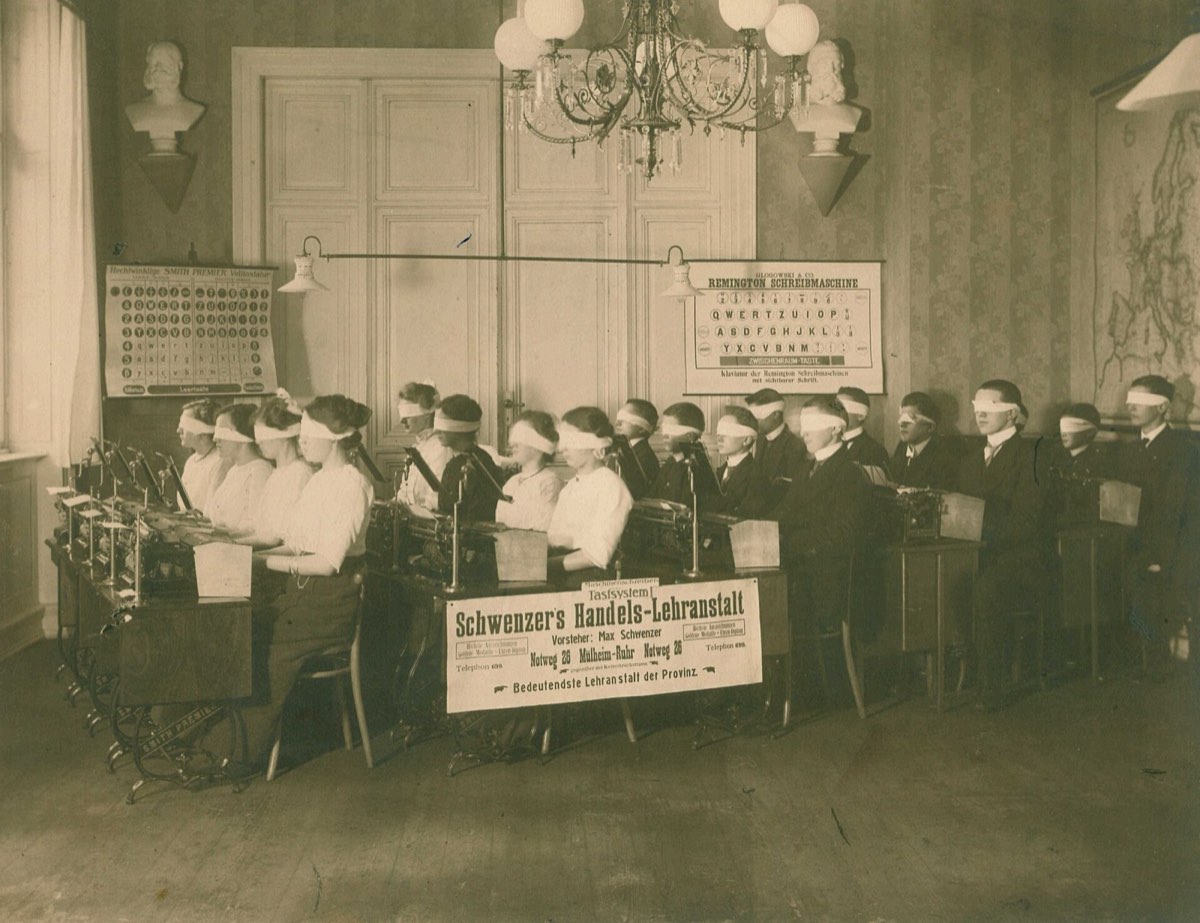
The first typists looked at the keys. Frank McGurrin, a court stenographer, taught himself in the late 1870s to type without looking. On 25 July 1888 in Cincinnati he met Louis Traub in a public contest. McGurrin used a Remington and typed by touch. Traub used a Caligraph with its full keyboard and an eight-finger method. McGurrin won decisively and collected $500, and the newspapers reported it widely.
Whether McGurrin was really the first touch typist is disputed, because speeds recorded by other typists at the time suggest some of them typed the same way. The contest made the method famous, and typing schools went on to teach it.
Portables
Office machines were heavy. George Blickensderfer showed a different kind of typewriter at the Chicago World's Fair in 1893. His No. 5 printed from a small rotating typewheel in place of typebars, had about 250 parts where an office machine had some 2,500, and sold for $35 when standard machines cost $100 or more. It was the first full-keyboard typewriter that could reasonably be carried.
The portable with typebars came a little later. A folding machine was put on the market in the first decade of the century as the Standard Folding, and its third version, the Corona 3 of 1912, sold in the hundreds of thousands. It had three rows of keys and two shifts, and its carriage folded down over the keyboard. Reporters carried it through the First World War.
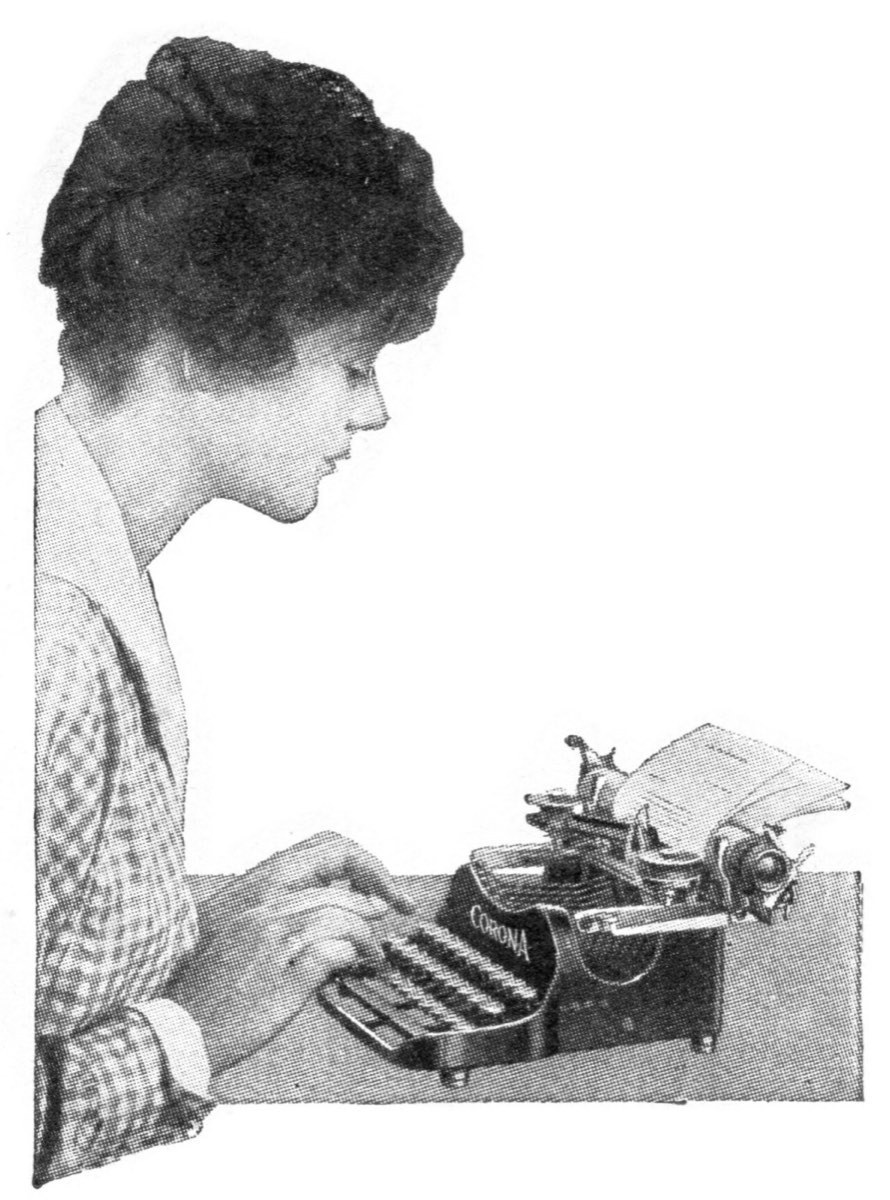
Royal brought out its portable in 1926. The Swiss Hermes Baby of 1935 stood about six centimetres high, and Olivetti's Lettera 22 of 1950 was one of the best known portables of the post-war years.
Electric typewriters and the Selectric
Blickensderfer also built an electric typewriter, shown at Buffalo in 1901. Few offices had suitable current, and it failed commercially.
The electric machine that lasted began with James Smathers of Kansas City, who devised a power-driven typewriter in 1914. A motor maker in Rochester, New York, developed his design. Remington sold about 2,500 electric machines built on it in 1925, and the Rochester firm launched its own Electromatic in 1929. IBM bought the Electromatic business in 1933, spent a million dollars redesigning the machine and released its Model 01 in 1935. In 1944 came the IBM Executive, which gave wide and narrow letters different amounts of space, so a typed page began to look printed.
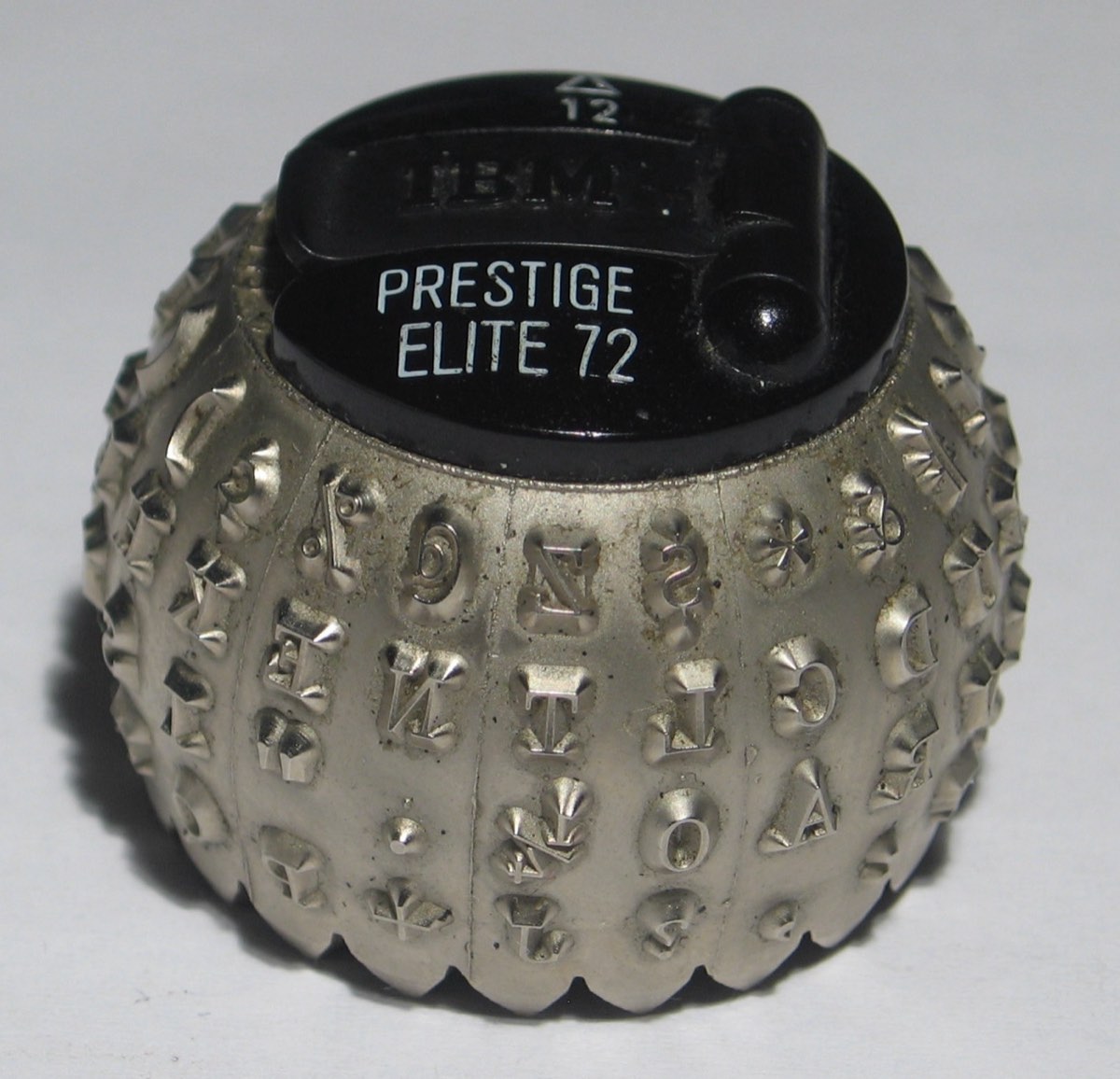
On 31 July 1961 IBM introduced the Selectric. It has no typebars and no moving carriage. All 88 characters sit on a ball about the size of a golf ball, which tilts, turns and strikes while it travels along the line. With no typebars the machine cannot jam, and changing the ball changes the typeface. IBM sold more than 13 million. The Correcting Selectric of 1973 added a tape that lifted a wrong letter off the page.
Daisy wheels, electronic typewriters and the word processor
In 1964 IBM coupled a Selectric to a magnetic tape unit. The MT/ST could store what was typed, play it back and let a typist correct a line without retyping the page. IBM itself calls it the first word processing device.
The next print element came from the computer industry. Around 1970 a team at Diablo Systems, led by Andrew Gabor, developed the daisy wheel: a flat disc of spokes with a character at the tip of each. It printed two to three times as fast as a Selectric ball. Electronic typewriters built around it reached offices in the late 1970s. Olivetti's ET 101 came out in 1978, and makers in Japan and elsewhere followed with machines of their own.
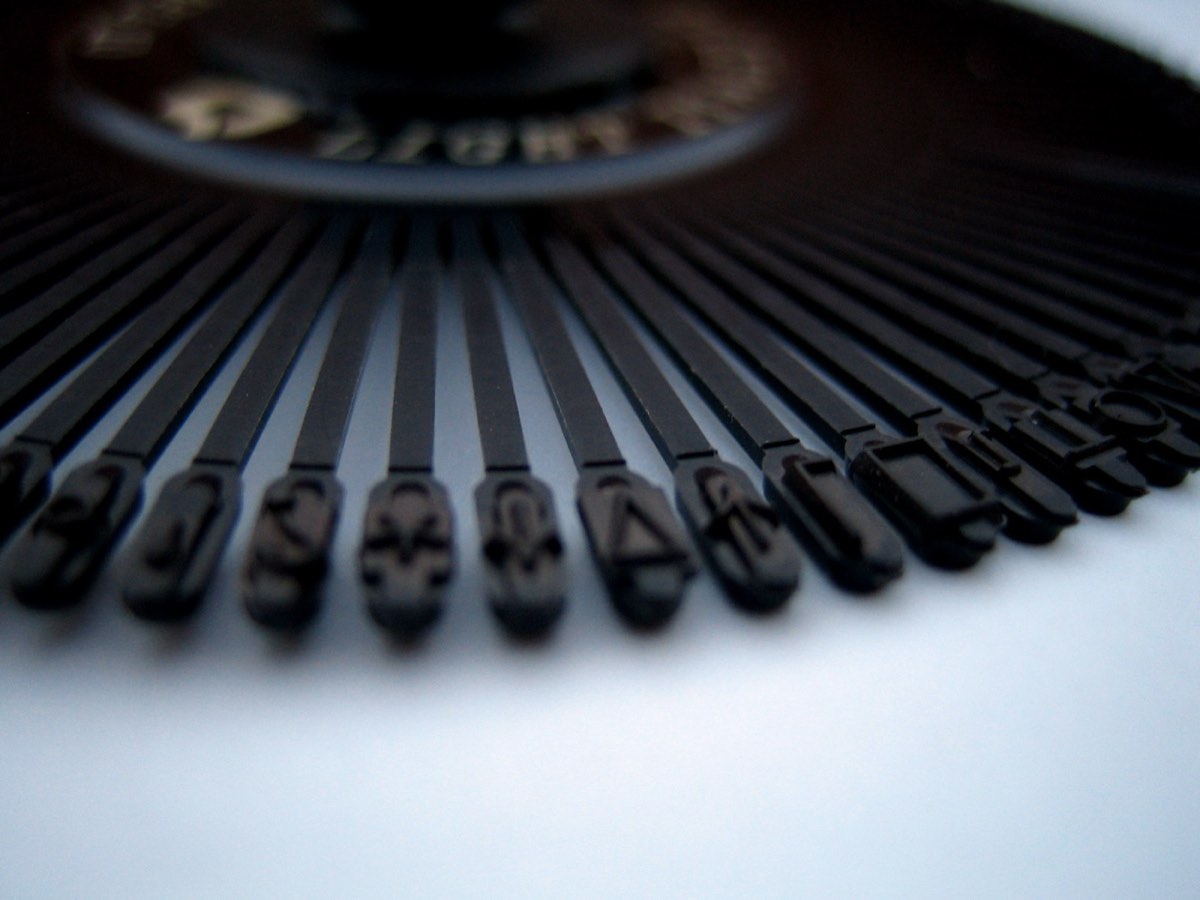
By then the typewriter was competing with the screen. Dedicated word processors with video displays spread through large offices in the 1970s, and word processing programs for small computers followed, among them Electric Pencil in 1976 and WordStar in 1978.
The withdrawal took about twenty years. IBM replaced the Selectric with the daisy wheel Wheelwriter in 1984 and sold its typewriter, printer and keyboard business in 1991, when it became Lexmark. Smith Corona moved its remaining production to Mexico in 1995 and went into bankruptcy soon afterwards. Brother built its last British typewriter at its factory near Wrexham in 2012 and gave it to the Science Museum in London.
Typewriters for other scripts
A typebar machine suits alphabets of a few dozen letters. Other scripts needed more than a change of type.
Arabic is written from right to left and its letters change shape with their position in a word. Arabic typewriters ran the carriage the other way and gave letters several forms. The first patents for an Arabic layout date from 1899.
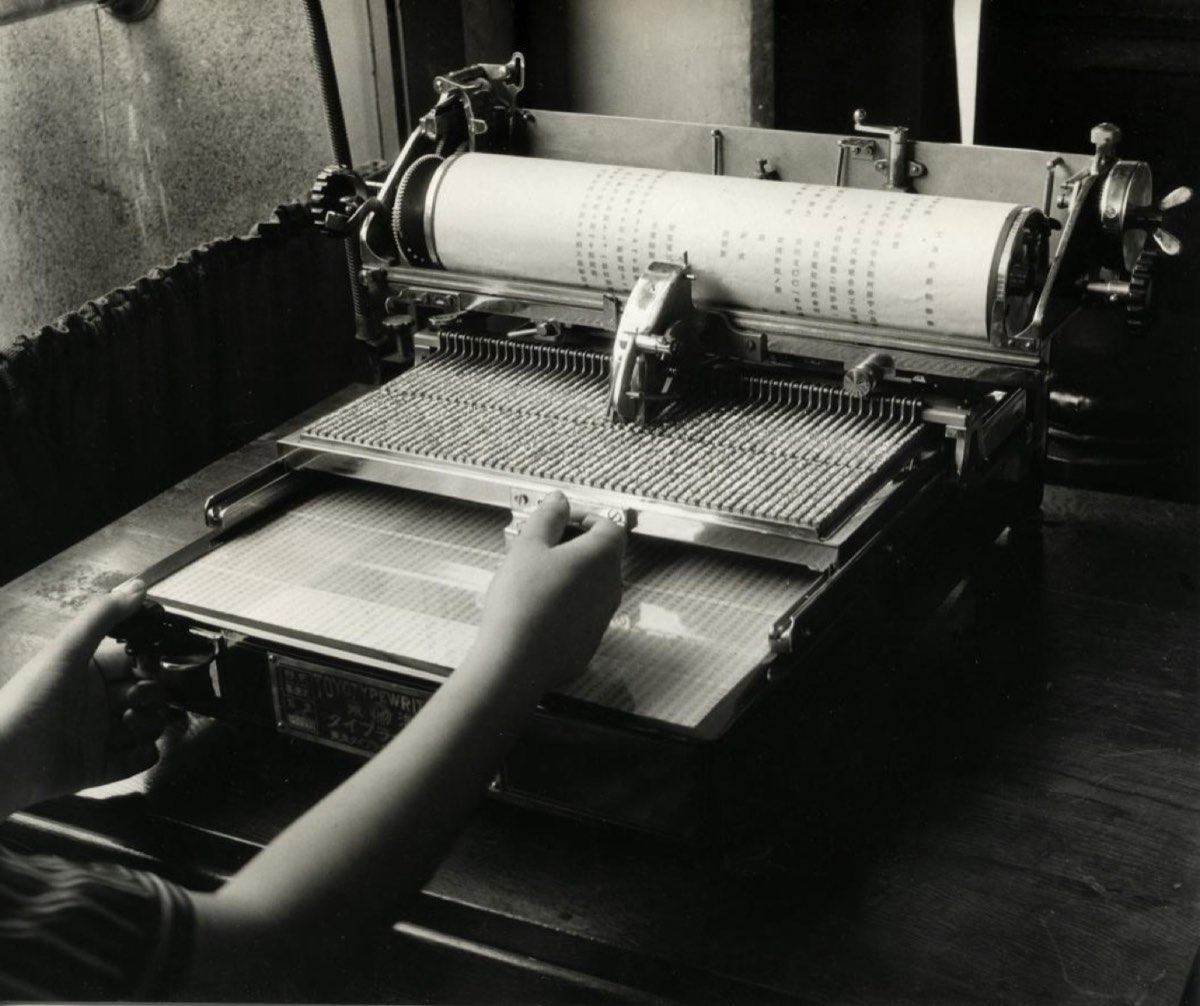
Chinese and Japanese could not be reduced to a keyboard at all. Kyota Sugimoto's Japanese typewriter of 1915 held 2,400 characters as loose type in a flat tray. The typist moved a selector over the tray, and a lever picked up one piece of type, printed it and put it back. Chinese typewriters worked on the same principle. Zhou Houkun built a prototype in 1914, and an improved version entered mass production at the Commercial Press in Shanghai in 1919. Tray machines stayed in use until word processors replaced them in the 1980s.
Typewriters in India
Arrival under British administration
Typewriters reached India as imports around the end of the nineteenth century. The historian David Arnold, who has written the fullest account, says they changed office life there as they had in Britain and the United States, at a slightly later date.
The largest customer was the government. Until at least the 1920s, Arnold writes, the state employed far more typists than private firms did, and typewriter companies looked to government departments for most of their sales and repair contracts. In 1904 the Bombay Typewriter Company printed a list of its clients on its letterhead: a few business houses and members of the nobility, and then the Government of India, revenue and public works departments, provincial high courts and sanitary officers. Law courts were among the first state institutions to be supplied with typists and machines.
Commercial offices followed, and typing and shorthand were taught commercially from early on. A guide to Ceylon published in 1907 records a Miss Violet Muthukrishna who learned both in Madras and opened a training institute in Colombo in 1901. Typing became a common route into office work for young men from south India in particular, many of whom moved north to work as stenographers. In Madras the Stenographers' Guild was founded on 26 September 1937, with C. Rajagopalachari presiding at its first meeting.
Machines for Indian scripts
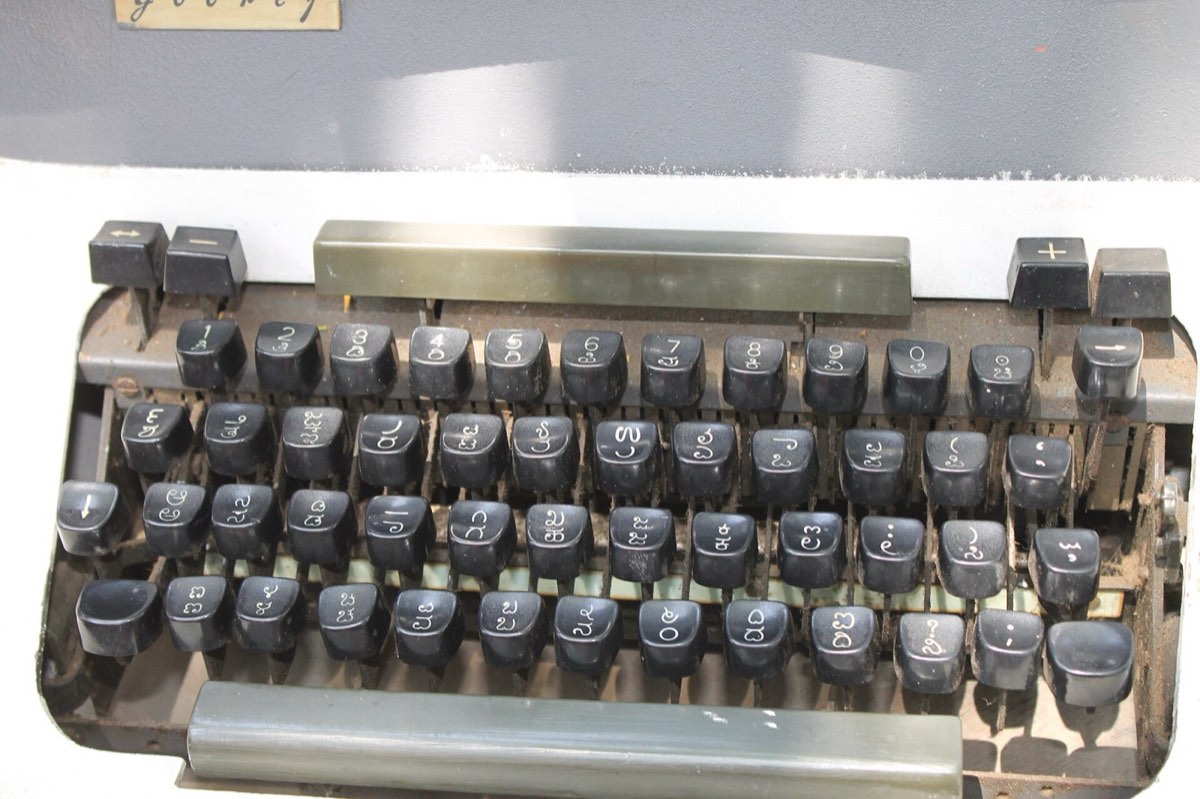
Indian scripts were a hard problem for a machine with some 44 keys. Vowel signs attach above, below and beside consonants, and consonants join into conjunct forms. Remington is the name most associated with the first solutions. According to Arnold, the company offered machines in Marathi, Gujarati, Devanagari, Urdu, Arabic and Gurmukhi from about 1910, and two decades later Hindi typists were a regular part of government offices in northern India. Bapurao Naik's history of Devanagari typography also records a machine called the Nagari Lekhan Yantra, designed by V. M. Atre and built in Germany, though the accounts available do not date it clearly.
Dates for the other scripts are less well documented. One history of the Telugu typewriter records an experimental Malayalam machine built in Travancore in 1928, a Kannada keyboard in 1933 and a hundred Telugu machines made by Royal in 1936. The Tamil typewriter is often credited to R. Muttiah of Jaffna, in what is now Sri Lanka, with dates in the 1920s, but the sources consulted for this article do not settle who was first or when. For Bengali, the scholar Munier Choudhury redesigned the keyboard in 1965, in what was then East Pakistan, and his Munier-Optima layout became the usual one on typewriters in Bangladesh.
Fitting a script onto a keyboard sometimes changed the script. In the early 1950s a conference convened by the Government of India at Lucknow fixed one standard set of letter forms for Devanagari with the typewriter in mind, and modern Hindi printing still follows it. In 1971 the government of Kerala simplified the way Malayalam vowel signs join their consonants, a reform prompted by the development of a Malayalam typewriter.
Godrej and the first typewriter made in India
Until the 1950s every typewriter in India was imported, whole or as parts for assembly. After Independence, industrial policy under Jawaharlal Nehru's government favoured manufacture inside the country, and typewriters were one of the products licensed. By one account three licences were issued, one in each of the large port cities: Remington Rand in Calcutta, Godrej and Boyce in Bombay, and Rayala Corporation in Madras, which made the Swedish Halda.
Godrej and Boyce was a Bombay maker of locks, safes and steel cupboards. Naval Godrej had planned a typewriter since the late 1940s. The sources give 1946, 1947 and 1948 for the idea, and agree that work was delayed while the firm made ballot boxes for the first general election. The machine was shown in 1955 and sold as the All-Indian typewriter. It had about 1,800 parts, of which, by the company's own history, only four were imported. One history of the Madras industry puts the Godrej launch in 1954, Remington's in 1955 and the first Halda assembled in Madras on 13 March 1956.
Nehru's part was that of patron, not designer. Photographs in the Godrej Archives show him trying the machine and President Rajendra Prasad being shown it at the Indian Industries Fair in 1955. Nehru spoke of the typewriter as a symbol of an independent and industrialised India. Press accounts often add that Godrej was the first company in Asia to make typewriters, which is hard to square with the typewriters built in Japan from 1915.
By the company's figures Godrej made about 50,000 typewriters a year in the 1990s, out of roughly 150,000 made in India, in English and in Indian scripts. It exported to Indonesia, the Philippines, Sri Lanka, Angola, Mozambique and Morocco, and made Arabic machines for export. Its last model was the Godrej Prima.
Street typists, typing institutes and exams
In most countries the typewriter stayed indoors. In India it also worked on the pavement. Typists set up outside courts, post offices and government buildings and typed petitions, affidavits, deeds and applications for people who could not produce them themselves. In July 1936 the Illustrated Weekly of India complained that typists had "planted themselves on the pavement" outside the General Post Office in Bombay.
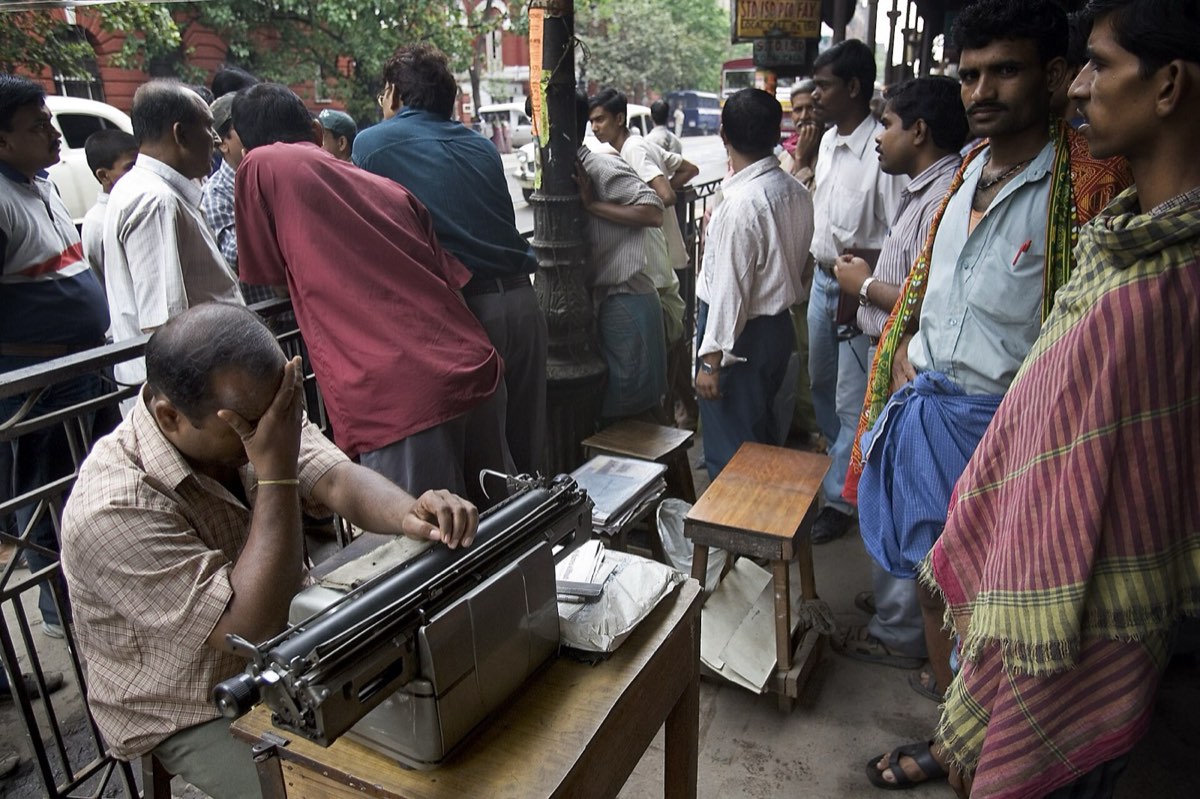
The trade has shrunk but not ended. In 2016 an Al Jazeera reporter counted fifty to sixty typists on the pavement beside the Calcutta High Court, charging about ten rupees a page and five more for each carbon copy. The same year a writer for The Caravan found typists at a district court in West Bengal, some with Bengali-script machines. A manual typewriter needs no electricity.
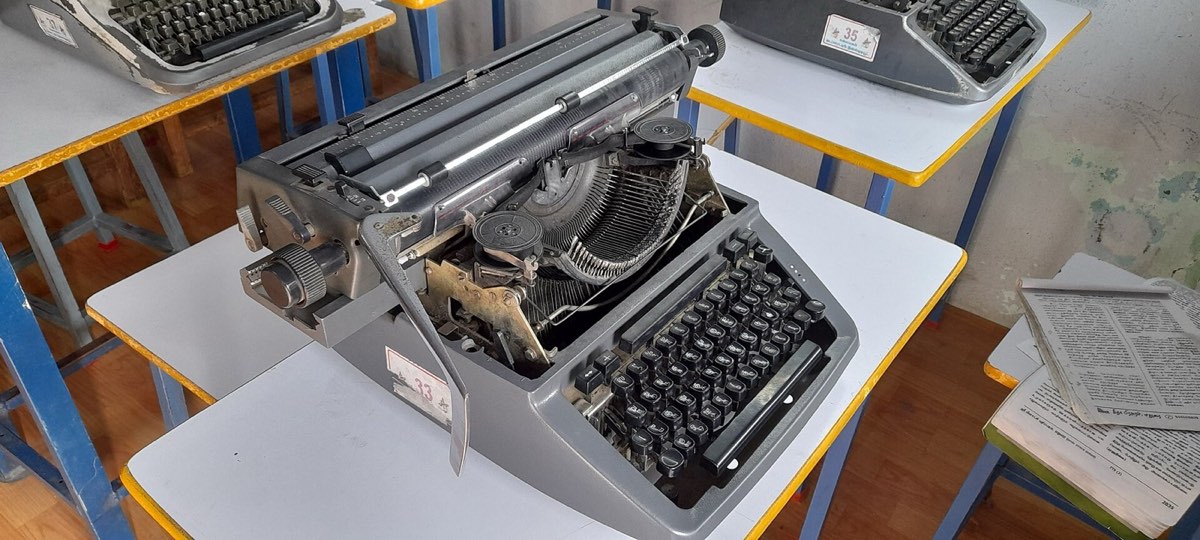
Typing institutes fed the offices. For decades a typing certificate at a set speed was a requirement for clerical posts in government, and state boards examined candidates on manual machines. Maharashtra held its last manual typewriting examination on 12 August 2017 and moved the test to computers. Its typing institutes, about 3,500 by their association's count, objected. In Chennai the Stenographers' Guild was still teaching several hundred students a month on old Facit and Godrej machines at about the same date, partly for a government examination held on typewriters.
The end of Godrej production
The other Indian makers closed first. A former Remington employee dates the end of that company's Indian operation to 1997, and Gulf News gives 2004 for the end of Facit, the successor to Halda. Godrej kept going, making 10,000 to 12,000 machines a year, until 2009. Its typewriter plant at Shirwal, near Pune, was turned over to refrigerators.
The closure went unreported for two years. In April 2011 the Business Standard noted that Godrej had about 500 machines left to sell, at up to 12,000 rupees each. "We stopped production in 2009 and were the last company in the world to manufacture office typewriters," its general manager for operations, Milind Dukle, told the paper. British and American outlets then ran the story under headlines announcing that the last typewriter factory in the world had closed.
That claim was wrong, and it was corrected within days. NPR pointed out that Swintec in New Jersey and Brother were still selling new typewriters. Those were mostly electronic machines made in Asia, but they were typewriters. Dukle's own claim was narrower. He told Gulf News that Godrej was the last to stop making heavy office typewriters, "though there could be others still producing the light portable ones". Whether Godrej was even the last maker of manual machines has not been established. What can be said is that it was the last maker of manual office typewriters in India, that it stopped in 2009 and not 2011, and that it still had a few hundred machines in stock when the headlines appeared.
Writers and the typewriter
Mark Twain bought a Sholes and Glidden in 1874 and was typing letters on it by December. He later claimed to have been the first author to give a publisher a typewritten book. He named Tom Sawyer, but researchers think his memory was at fault and that the book was Life on the Mississippi, published in 1883.
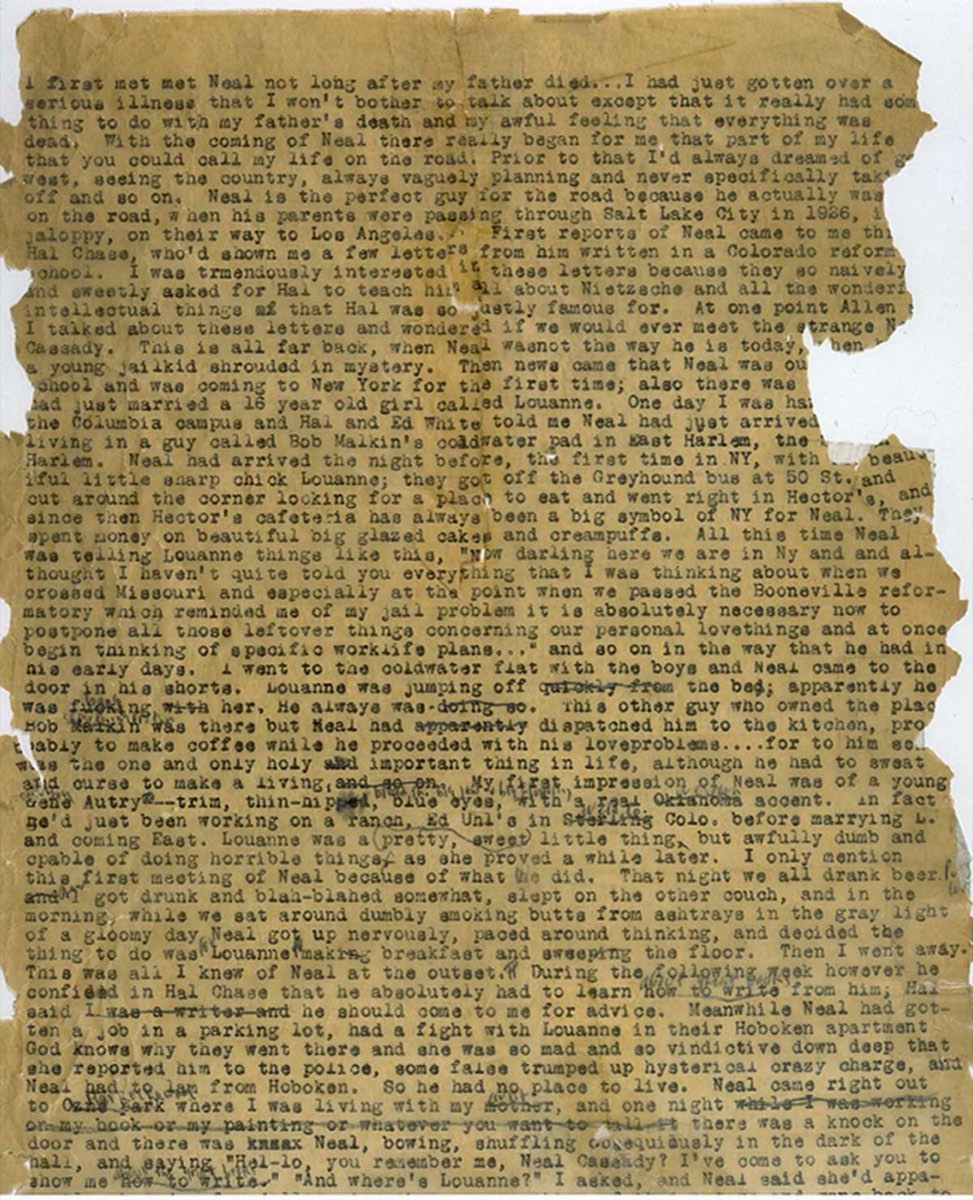
Henry James dictated to a typist. Nietzsche, typing on his Writing Ball in 1882, remarked that writing tools work on our thoughts. Jack Kerouac typed the first draft of On the Road in three weeks in April 1951 on a scroll of paper about 120 feet long, taped together so that he would not have to stop to change sheets.
Cormac McCarthy wrote nearly all his work on an Olivetti Lettera 32 bought second-hand in the early 1960s. The machine was sold at Christie's in December 2009 for $254,500, and he replaced it with another of the same model.
Typewriter timeline
- The first patent
Henry Mill receives an English patent for a machine for impressing letters one after another. No drawing or machine survives.
- A machine for a blind writer
Pellegrino Turri builds a writing machine for Countess Carolina Fantoni da Fivizzano. Accounts date it between 1801 and 1808.
- Burt's typographer
William Austin Burt patents the first writing machine in the United States. It selects letters with a lever.
- The scribe harpsichord
Giuseppe Ravizza patents his cembalo scrivano in Italy, with piano keys and type hammers in a ring.
- Azevedo in Rio
Father Francisco João de Azevedo shows a writing machine at Brazil's National Exhibition and receives a gold medal.
- Mitterhofer's first model
Peter Mitterhofer of South Tyrol begins a series of typewriter models that he continues until 1869.
- The Sholes patent
Sholes, Glidden and Soule receive US patent 79,265 for their type-writer on 23 June.
- First typewriter on sale
The Hansen Writing Ball, designed in 1865, is patented and goes into production.
- Remington signs
On 1 March E. Remington and Sons contracts to manufacture 1,000 Sholes and Glidden machines.
- The Sholes and Glidden goes on sale
The first commercially successful typewriter reaches the market on 1 July, with a QWERTY keyboard and capitals only.
- The shift key
The Remington No. 2 prints capitals and lowercase from the same keys.
- Index machines and typing classes
The Hall index typewriter appears, and the New York YWCA begins training women as typists.
- The Cincinnati contest
Frank McGurrin, typing by touch on a Remington, beats Louis Traub on a Caligraph on 25 July.
- The Underwood No. 1
Franz Xaver Wagner's front-strike design goes on sale, with the typed line in view.
- The Underwood No. 5
The machine that fixed the form of the manual typewriter is launched.
- An early electric
The Blickensderfer Electric is shown at Buffalo. It works, and it does not sell.
- The Corona 3
A folding portable with three rows of keys goes into production and sells in the hundreds of thousands.
- The Japanese typewriter
Kyota Sugimoto builds a machine that picks 2,400 characters from a tray of type.
- IBM's first electric
IBM releases the Model 01, developed from the Electromatic it bought in 1933.
- The first typewriter made in India
Godrej and Boyce of Bombay shows its All-Indian typewriter. One account dates the launch to 1954.
- The Selectric
IBM replaces typebars and the moving carriage with a single type ball on 31 July.
- The Correcting Selectric
A lift-off tape removes a mistyped letter from the page.
- Electronic typewriters
Olivetti's ET 101 appears as daisy wheel electronic machines begin to replace electrics. WordStar is written the same year.
- IBM leaves the business
IBM's typewriter, printer and keyboard operations are sold and become Lexmark.
- Godrej stops production
The last Indian maker of manual office typewriters ends manufacture. The news breaks in 2011.
- The last British typewriter
Brother builds its final typewriter in Wales and gives it to the Science Museum.
What the typewriter left behind
- QWERTY. The letter layout of the 1870s is on nearly every keyboard and phone used for English.
- Shift. The key no longer moves anything. On the Remington No. 2 it shifted the platen.
- Return, Tab and Backspace. The Return key is named after the carriage return, Tab after the tabulator that moved the carriage to a set column, and Backspace after the key that stepped the carriage back one space. Computer text still marks the end of a line with characters called carriage return and line feed.
- cc. The copy line in email stands for carbon copy, a duplicate made with a sheet of carbon paper between two sheets in the machine.
There is also a small revival among collectors, repair shops and writers, and Richard Polt's book The Typewriter Revolution sets out the case for it. If you want the mechanism without the ribbon, Typebar is a typewriter simulator that runs in the browser: each strike inks the page and steps the carriage, the bell rings near the right margin, and the return lever starts a new line.
Sources
- David Arnold, "Typewriters, Writing a Social History of Urban India", The Wire (excerpt from With Great Truth and Regards, edited by Sidharth Bhatia, Godrej, 2016)
- "The Small Technologies That Have Powered India Just Like Dams and the Railways Have", The Wire (on David Arnold's Everyday Technology, University of Chicago Press, 2013)
- Koichi Yasuoka and Motoko Yasuoka, study of the origins of the QWERTY layout, Kyoto University
- Margery W. Davies, Woman's Place Is at the Typewriter, chapter 4, Temple University Press
- IBM, "The IBM Selectric"
- The International Rasmus Malling-Hansen Society, "The Writing Ball"
- Science Museum Group, Brother electronic typewriter, 2012
- Business Standard, "Typewriters about to become a page in history", April 2011
- Gulf News, "World's last typewriter factory shuts shop", 2011
- NPR, "Has The Last Typewriter Factory Closed? Not Really", 26 April 2011
- Business Today, "Godrej and Boyce is one of the 100-year-old Indian companies"
- "The Halda junction", Madras Musings
- "The South Indian and typing", Madras Musings
- "The swadesi typewriter: mediating modernity, identity, and technology in post-independence India", Design History Society
- Karthik Malli, "Typewriters, Script, and Modernity in India", Script Encoding Initiative, UC Berkeley
- Dick Plukker, "Hindi Typewriters", Indology list, January 2000 (quoting Bapurao S. Naik, Typography of Devanagari, 1971)
- John Castellas, "How the first Telugu typewriter scripted history", Yo! Vizag
- The Better India, "Godrej typewriter" history
- Al Jazeera, "Meet the men keeping the typewriter alive in India", June 2016
- The Caravan, "Why Typewriters Continue to be Relevant in the Indian Judiciary"
- Scroll.in, on typewriter repair in Kolkata, 2016
- PTI in Business Standard, "Maha set to bid adieu to typewriters", August 2017
- Wikipedia, checked against the sources above where possible: Typewriter, Sholes and Glidden typewriter, Hansen Writing Ball, Henry Mill, Pellegrino Turri, Typographer, Giuseppe Ravizza, Francisco João de Azevedo, Frank E. McGurrin, Underwood Typewriter Company, Blickensderfer typewriter, IBM Electric, Daisy wheel printing, Chinese typewriter, Japanese typewriter, Bengali input methods, On the Road
Questions people ask
- Who invented the typewriter?
- No single person did. Henry Mill patented a writing machine in England in 1714, William Austin Burt patented the typographer in the United States in 1829, and Rasmus Malling-Hansen's Writing Ball was the first machine produced for sale, from 1870. The design that modern keyboards descend from was patented in 1868 by Christopher Latham Sholes, Carlos Glidden and Samuel W. Soule.
- When was the typewriter invented?
- The first patent dates from 1714, and working one-off machines existed in Italy by about 1808. The first typewriter sold commercially was the Hansen Writing Ball, patented in 1870. The first commercially successful one, the Sholes and Glidden made by Remington, went on sale on 1 July 1874.
- What was the first typewriter?
- It depends on the test. The first patent was Henry Mill's in 1714, but no drawing or machine survives. The first typewriter produced for sale was the Hansen Writing Ball of 1870. The first to succeed commercially was the Sholes and Glidden, also called the Remington No. 1, of 1874.
- Why is the keyboard arranged as QWERTY?
- The layout was worked out by Sholes and his backers between about 1868 and 1873 and finished at Remington. The usual explanation is that common letter pairs were separated to stop typebars jamming. Researchers at Kyoto University dispute that and argue the layout was shaped by telegraph operators, the first customers. Historians do not agree.
- When did typewriters come to India?
- Typewriters reached Indian offices around the end of the nineteenth century, a little later than in Britain and the United States. By 1904 a Bombay dealer listed the Government of India, provincial high courts and many departments among its clients. Remington was selling machines in several Indian scripts by the 1910s.
- Who made the first typewriter in India?
- Godrej and Boyce of Bombay launched the first typewriter manufactured in India in 1955, though one account dates the launch to 1954. Remington Rand in Calcutta and the Halda licensee in Madras followed within about a year. Godrej stopped production in 2009.
- Are typewriters still made?
- Yes, in small numbers. Godrej stopped making office manuals in 2009, and the 2011 headlines calling it the last typewriter factory in the world were wrong: electronic typewriters were still being made and sold by other companies. Brother built its last British typewriter in 2012.